Welcome to another Friday Reads blog My featured book this week is the gripping and unforgettable World War 2 historical novel Last Agent in Paris by Sharon Maas, which was inspired by a true story.
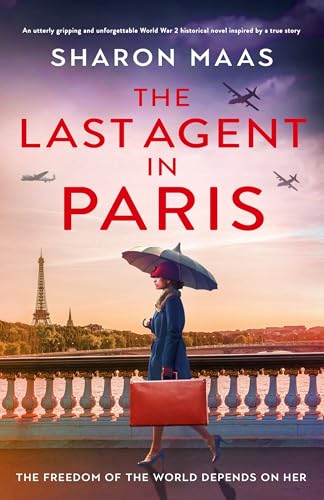
Blurb
As the bombs rained down on Paris, my family fled before the Nazis could take us. I never thought I’d see my beloved home again. But I’ve come back to fight for the people I love. And now, I’m the last agent standing. The freedom of the world rests on my shoulders.
Paris, 1940. As Nazi soldiers march down the Champs Elysees, Noor’s heart is shattered. Her family is forced to flee their home to the safety of England, and as Noor watches the French coast disappear in the distance, she vows to do everything she can to stop Germany from devouring her beloved country.
Training as a wireless operative in England, Noor’s perfect French makes her the ideal candidate for undercover work in her beloved Paris, and she is soon assigned to an illustrious spy network led by a mysterious man named Prosper.
Day after day, Noor walks the treacherous streets of Paris looking for safe places to broadcast messages to London. But Nazi officers lurk around every corner, and Noor’s heart thunders in her chest as she evades detection, tightly clutching the briefcase containing her radio equipment. She knows it would take just one stop and search for her life to be over.
With each passing day her mission becomes more lethal as, one by one, her fellow agents are captured. Someone is betraying them, but who? And when Noor becomes the last agent in the network, can she keep the links with England alive, to help win the war?
Buy Links
Amazon: https://ow.ly/25KT50TZtEX
Apple Books: https://ow.ly/nBhT50TVaHo
Kobo: https://ow.ly/ZYct50TVaHq
Google Play: https://ow.ly/mfhq50TVaHp
Sharon has written this article to tell us what inspired her to become a writer.
The Sound of Silence: where stories are born.
I’ve always been in search of a voice. As a child, I had no voice at all. For several years I was, quite literally, mute. Tongue-tied. I refused to speak. It was as if I’d taken a vow never to let my voice be heard by anyone outside my closest family circle. I was adamant about it. Stubborn. Relentless. Perhaps rude: I distinctly remember sitting in dad’s car, on the passenger seat, and chatting normally with him, when, to my horror, one of my aunties, sitting in the back seat, made a remark.
She had heard my voice! Shock, horror! Shame! I clammed up immediately, and at the first opportunity leapt from the car and ran away.
It was only much, much later, as an adult, that I uncovered the reason for my muteness, and all at once, everything became clear.
Tongue-tie is a fairly common condition: the piece of skin connecting my tongue to the bottom of my mouth was too short, too tight. The medical term is ankyloglossia, and these days it’s usually treated promptly, and there’s no more problem. But in the early 50s we had to live with it, which meant that my speech was unclear, slurred. Maybe I stuttered; I’ve no memory of this, and no memory of the teasing, perhaps mocking, that accompanied my attempts to speak.
I learned of the mockery much later, through others, and at once I understood. I understood my retreat into silence, and the solace I found there, as well as the skill.
I loved words, but refusing communication with others, I found refuge in books. Enid Blyton was my first favourite author. I devoured her books, progressing through Noddy to the Faraway Tree, ending up with The Famous Five and co. Those were glorious years; I found worlds within worlds, all through the magic of words; words that became stories in which I could lose myself, and in which I found refuge.
I began to make up my own worlds, my own characters, my own stories, and write them down. Adventure stories, invariably set in England, the characters always English children, with names like Sally and Tim. There’d be dogs and horses, and robbers to catch and mysteries to solve. It was glorious.
Looking back, I think I had a lucky escape. These days, I’d have probably been diagnosed as autistic, or dragged from one speech therapist to the other. I doubt if any of them could have helped: obstinate as I was, I’d have clammed up all the more.
Instead, I cured myself. At some point, I began to speak, one word at a time, and by the age of ten I was almost normal.
Up to this day I speak slowly, carefully enunciating each word, a silent mentor filtering speech at the back of my mind. And while I feel respect and admiration at those who speak fluently, skilfully, and quickly, I know that that will never be me.
But the internal worlds I found access to as a child: they’re still here, deep inside, in a silent place where stories are born, and from which they flow.
I’m content to listen to that silent voice and write the stories it tells.
What an inspiring article, Sharon. I think we all need to listen to that silent voice within us.
Meet Sharon

BIO
I was born in Georgetown, Guyana in 1951, and a sense of adventure has followed me around the world. In 1971 I spent a year backpacking around South America, followed by a few months with pioneering friends in the Guyana rainforest, followed by an overland trip to India, followed by a year in a Hindu Ashram.
I finally settled in Germany where I married, studied, worked, and raised children.
My first novel was published by HarperCollins in 1999, followed by two more in 2001 and 2002. At present, I’ve 17 published works with the digital publisher Bookouture.
Now I’m officially retired; I continue to write from my new home in India – but T a much slower pace.
THe Last Agent in Paris
The Last Agent in Paris has been a labour of love. While researching for other WW2 novels back in 2018, I came across the SOE agent Noor Inayat Khan. I fell in love, and knew I had to dedicate a book to her some time in the future. She was an extraordinary woman, a true heroine of great courage, and I believe we must honour her memory.
Contact links
X: @sharon_maas
Thank you for dropping by to talk to us today, Sharon. Your book sounds fantastic. I hope you sell shed loads!
 Karen King